
Divine Tension: Embracing the Fullness of God’s Truth (Part 3)
In the physical world, dynamic forces must work in opposition to create environments where life can flourish. Consider a mighty river: it requires two opposing realities to exist. It needs the kinetic energy of flow to move water forward, providing life and hydration downstream. Yet it equally requires the static resistance of banks to contain that energy. Without the flow, the river becomes a stagnant swamp; without the banks, it becomes a destructive flood.
We see a similar tension in the plant kingdom. A tree requires a root system that digs deep into the dark earth for stability and nutrients, contrasting with branches that reach high into the sunlight for photosynthesis. The downward grounding and the upward reaching are not contradictions; they are the combined, necessary mechanics of growth. It is not one or the other, it’s both/and. In the same way, the church thrives when we recognize and embrace the divine tensions God built into its design.
In Part 1 we established that the fullness of God’s truth is held in tension, rather than in simplistic either–or categories. We must apply this lens to a topic that often causes confusion and conflict: church culture.
The ecclesiological tension: many models, one church
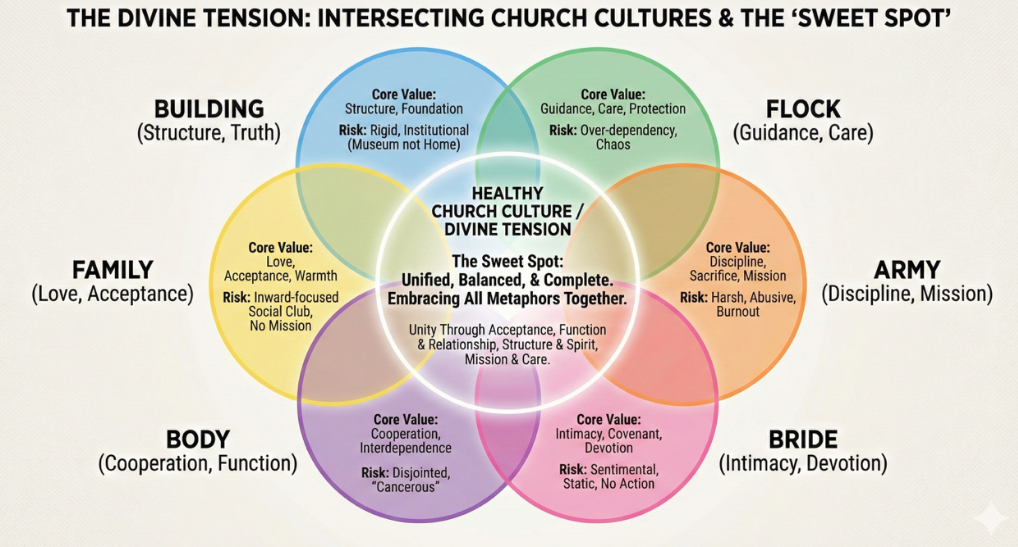
When we ask, “What is the church supposed to be like?” we often look for a single, simple definition. But Scripture does not offer us one static image. Instead, it presents a kaleidoscope of metaphors, each holding the others in check. The church is described most frequently as a family, a body, an army, a flock, a bride, and a building.
Each of these models carries a unique culture and set of expectations. The tension arises because these archetypes describe realities that, on the surface, seem to pull in opposite directions.
The static and the living: the building and the flock
A tension exists between the stability of the building and the movement of the flock. These two images present a necessary contrast between established structure and organic care.
The church as a building:
Scripture describes the church as “God’s household” (1 Timothy 3:15) and a structure built on a foundation (Ephesians 2:19-22). 1 Corinthians 3:9 tells Christians, “we are…God’s building.” A building represents permanence, shelter, and order. It requires a strong foundation and structural integrity to stand. Jesus fulfils that as the chief cornerstone. See also 1 Peter 2:5, Hebrews 3:6.
In this mode, the focus is on structure and truth. It provides the walls that define what we believe and the roof that covers us. Without this structure, the church has no location or definition; it becomes formless and lacks conviction.
The church as a flock:
In contrast, the church is also called a flock (Acts 20:28). A flock is a living, breathing entity that needs guidance, food, and protection. It is defined not by walls, but by movement and the voice of the Shepherd. (Luke 12:32, John 10:11-16, 1 Peter 5:2-4)
In this mode, the focus is on guidance and care. A flock wanders; it gets hungry; it gets scared. It needs a shepherd to lead it to green pastures, not just a foundation to stand on.
The tension:
The divine tension here lies between structure and Spirit.
- If we emphasize the building to the exclusion of the flock, the church risks becoming rigid or institutional—a museum rather than a home. We may have perfect doctrine (foundation), but no life inside the walls.
- Conversely, if we view ourselves only as a flock without the structure of the building, we risk chaos and vulnerability. A flock without a pen is exposed to predators; a movement without a structure eventually dissipates.
We need the solid “walls” of truth and structure (building) to protect the vulnerable, wandering life of the sheep (flock). We must be grounded enough to stand firm, yet mobile enough to follow the Shepherd’s leading. Pauls sums it up in 1 Timothy 4:16 “Watch your life and doctrine closely,” re-enforcing the both/and nature of divine tension.
The warmth of the family vs. the discipline of the army
One of the most profound tensions in church culture exists between the concept of the family and the army.
The church as a family:
Scripture is clear that we are God’s household. Ephesians 2:19 “Consequently, you are no longer foreigners and strangers, but fellow citizens with God’s people and also members of his household.” In a healthy family, the dominant culture is one of love, acceptance, and unconditional care. We are called to “do good to all people, especially those who belong to the family of believers” (Galatians 6:10).
In this mode, the church focuses on warmth and empathy. It is the place where we ask, “Are you feeling sick? Let us take care of you.” It is a culture of celebrations, acceptance, friendships, and safety. (See also, 1 Timothy 3:14-15, Hebrews 2:11.)
The church as an army:
Yet, the New Testament also describes the church as a military force engaged in spiritual warfare. 2 Corinthians 10:3-5 reminds us that “we do not wage war as the world does,” but we are waging war nonetheless. We are also commanded to endure hardship like “a good soldier of Christ” (2 Timothy 2:3). This then extends to the communal mission of the spiritual battle, as seen in Philippians 2:25, where believers are called “fellow soldiers” who are told to put on the “full armor of God” (Ephesians 6:10-17). Furthermore, Revelation 12 depicts the devil making war against the collective offspring of the woman, the people of God. All these military metaphors affirm this as a biblical motif; the warfare is corporate; therefore, the martial reality must also be corporate. (See also, Philemon 1:2 and 1 Peter 2:11.)
In an army, the culture is defined by commitment, courage, discipline, obedience, and sacrifice. The songs we sing in church often reflect this reality: “Soldiers of Christ arise” or “You’re a hard-fighting soldier on the battlefield.”
The tension:
Here is where the divine tension lies. An army without the love of a family becomes a harsh, demanding regime. Many can attest to the wounds this type of environment, if unbalanced, can afflict. Conversely, a family without the mission of an army becomes an inward-focused social club, with little impact or influence on a lost world. We need to care deeply for the family of believers, but also care deeply about the mission of the church to reach the lost. We need the acceptance of the family and the discipline of the army to be the church God designed.
The organic and the intimate: the body and the bride
Another tension also exists between viewing the church as a functioning body and a cherished bride. These two images, found in Ephesians 4 and 5, present us with a duality of function and identity.
The church as a body:
Scripture emphasizes that we are the body of Christ, where “each one of you is a part of it” (1 Corinthians 12:27). This metaphor is driven by functional necessity and interdependence. In a body, there is cooperation, sharing, and specific roles. The tension here is that parts cannot exist in isolation; the “Boston body” cannot say it doesn’t need the “Chicago body,” nor can “Cape Town” claim independence from “Johannesburg.” In a physical body, when parts go rogue and refuse to submit to the head or work with one another, this is a disease we know as “cancer,” a disease that threatens the whole. In the spiritual body, isolation is not freedom; it is illness. The body is designed for cooperation—to act and achieve the instructions of the Head.
The church as a bride:
Yet, Ephesians and Corinthians also describe the church as the bride of Christ (Ephesians 5:25-27, 2 Corinthians 11:2). While the body speaks to how we work together, the bride speaks to who we are to Jesus. This image is not about mechanics, but about intimacy, covenant, and devotion.
The tension:
The divine tension here lies between industry and intimacy.
- If we emphasize the body to the exclusion of the bride, the church becomes a biological machine—efficient, busy, and structured, but devoid of passion and romance for Jesus. We become “hands and feet” that have forgotten the “heart.”
- Conversely, if we view ourselves only as a bride without the mechanics of the body, we risk becoming sentimental and static. We may enjoy the feeling of closeness to God but lack the coordinated movement required to serve the world and each other effectively.
We must live in the tension of being functionally connected to one another (body) while remaining relationally devoted to Christ (bride). We need the structure of the skeleton and the muscles of the army, but we also need the beating heart of the beloved.
The source of conflict: our bias
Why is this balance so hard to maintain? The challenge lies in our own internal preferences. Depending on our wiring, we are dominantly drawn toward one or two of these archetypes over the others. These tensions become difficult not because Scripture is unclear, but because we are biased.
For example, let’s take the family/army tension.
- Some of us love the family model: we crave love, care, and a judgment-free environment.
- Others are drawn to the army model: we value mission, radical sacrifice, and “getting stuff done.”
- When we enter a church community, we subconsciously try to pull or push the culture toward our preference. The “army” people get frustrated when the church seems too soft or slow. The “family” people get hurt when the church seems too demanding or structured. We find ourselves arguing over culture because we want the church to look like the model we prefer.
We have to understand our own bias before we can embrace the divine tension. Socrates said it like this, “know thyself.” Carl Jung tells us, “Your vision will become clear only when you look into your own heart. He who looks outside – dreams, the one who looks inside, awakens.” God simply tells us to “examine ourselves” (1 Corinthians 11:28). Our biases are formed by numerous things, from our personality types to lived experiences, to the echo chamber of our news sources (liberal or conservative). A key measure of spiritual maturity is self-awareness.
Embracing the tension: unity through acceptance
Romans 15:7 “Accept one another, then, just as Christ accepted you, in order to bring praise to God.” To embrace divine tension is to accept that the church will never fully match our personal ideal, and that’s a good thing. A healthy church requires every metaphor God gives us.
If a church becomes exclusively a building, it loses its heart. If it becomes exclusively a family, it loses its mission. True unity requires us to admit that the Bible gives us multiple models, not just one. This means giving up our insistence on getting everything our way so the whole body can flourish.
- The person who loves action and efficiency may need to slow down to care for the wounded (family).
- The person who loves care, comfort and stability will need to concede that flexibility and change are necessary for the growth of the church (flock).
The ultimate question we must ask ourselves is: Is the unity of the body precious enough for you to give up some of your personal preferences?
But what do we do when certain biblical metaphors, like the church as an army or a family, trigger discomfort or even pain? For some, the word “family” brings up memories of dysfunction and hurt. For others, the imagery of an army recalls experiences of harsh, militant church environments. Yet the solution is not to delete these metaphors from Scripture. As we learned when studying the Bible, “All Scripture is God-breathed,” and we are not free to treat the Bible like a buffet, keeping only the parts that feel comfortable. Any single metaphor, when pushed to an unhealthy extreme, can create distortion. That is precisely why God, in his wisdom, provides multiple images to describe his church. Only by embracing all of them together can we find balance, health, and maturity. And yes, living within that fullness inevitably creates tension.
Conclusion
Just as we learned in Part 1 to ask, “What is the lamb to this lion?”, we must now ask, “What metaphor of the church am I ignoring?” “Am I willing to accept and learn from people that are different from me to maintain the divine tension so the church can be complete?”
Until we appreciate the tension between these opposing images, we will not have a healthy church culture. By embracing the tension, we allow the church to be everything God intended: a disciplined army that fights with the love of a family, a structured building that lives with the organic connection of a body or flock. Everything is motivated by the passion of a bride.
For reflection:
- Which church metaphor (building, flock, family, army, body, or bride) do you naturally gravitate toward?
- How might your internal biases be creating blind spots in how you view your local church?
- Have you “opposed” people who are advocating for a biblical metaphor of the church you personally dislike?
- What are you willing to “sacrifice” to help maintain the divine tension in your community?
| Metaphor | Key scripture | Core value | Risk of imbalance (without tension) |
|---|---|---|---|
| Building | 1 Timothy 3:15 | Structure, foundation | Becomes rigid or institutional; a museum rather than a home. |
| Flock | Acts 20:28 | Guidance, care, protection | Can create over-dependency on leaders if not balanced with maturity. |
| Family | Galatians 6:10 | Love, acceptance, warmth | Becomes an inward-focused social club; lacks mission. |
| Army | 2 Timothy 2:3 | Discipline, sacrifice, mission | Becomes harsh or abusive; burns people out. |
| Body | 1 Cor 12:27 | Cooperation, interdependence | Becomes disjointed or “cancerous” if parts don’t submit to the Head. |
| Bride | Ephesians 5 | Intimacy, devotion | Becomes sentimental and static; lacks coordinated action. |
More from Southern African Churches of Christ