
Divine Tension: Embracing the Fullness of God’s Truth (Part 1)
Any serious reader of the Bible soon discovers an uncomfortable reality: the fullness of God’s truth is often held in tension. We see this in Scripture and in creation. We live in a world governed by intricate balances, from the vast expanse of the universe to the microscopic dance of atoms. We cannot avoid encountering a profound principle: divine tension. This concept, drawn from the very fabric of creation, reveals how opposing forces coexist to maintain harmony and wholeness.
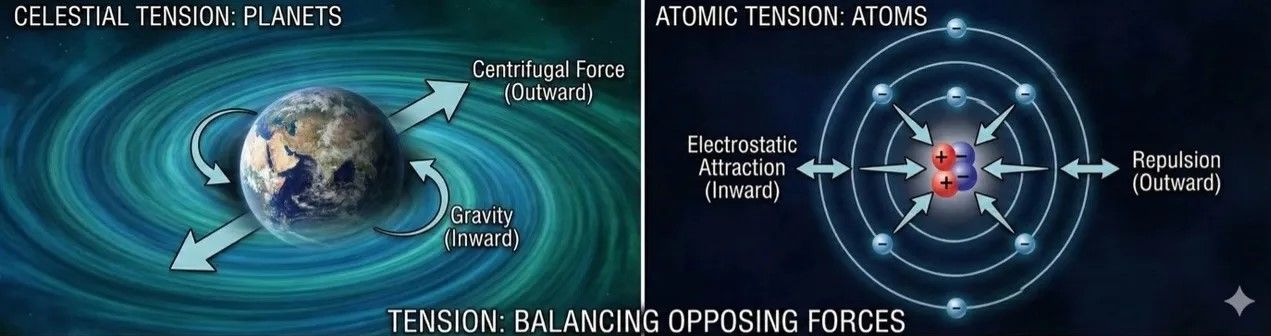
Consider the solar system, where gravity pulls planets inward while centrifugal force propels them outward, creating stable orbits. Scale it down to the atomic level, and you’ll find protons and electrons held in equilibrium by electromagnetic forces, or nuclei bound by strong and weak nuclear interactions. Even our own bodies embody this tension, requiring a delicate balance of eating, sleeping, and exercising to thrive. Imbalance leads to illness, just as excess or deficiency disrupts the natural order. This echoes Romans 1:20, where God’s invisible qualities are clearly seen in what has been made. This principle isn’t confined to the physical realm; it permeates the spiritual world as well, reflecting the character of God himself. The Bible is rich with examples where truths exist not in isolation but in dynamic tension. Each side complements the other to reveal the fullness of divine wisdom.
Tensions in creation and core doctrines
Faith and deeds, for instance, are like inhaling and exhaling—essential and interdependent. As James 2:26 declares, “Faith without deeds is dead.” Yet deeds performed without faith are equally futile, amounting to mere human effort devoid of spiritual life (cf. Isaiah 64:6, where even our righteous acts are like “filthy rags” apart from God). This does not mean non-believers’ good deeds lack any value under God’s common grace (Matthew 5:45), but they cannot achieve spiritual salvation without faith (Ephesians 2:8-9).
Similarly, repentance and grace form a sacred tension. Without repentance, grace is spurned—as Hebrews 10:26-31 warns against deliberately continuing in sin. But without grace, repentance becomes an impossible burden, for no one can atone through effort alone.
At its core, the fullness of God’s truth resides in this divine tension. We, as finite beings, often seek to resolve it, craving simplicity and closure. Our discomfort with ambiguity is evident in everyday life. Think of how Hollywood crafts narratives: tension builds with a villain’s threat or a romantic misunderstanding, heroes intervene, and resolution arrives, leaving audiences satisfied. While some appreciate open-ended stories, unresolved narratives often frustrate us, prompting complaints about “cliffhangers” or “poor scripting.” Yet, in reality, embracing tension fosters balance and depth. Resolving it prematurely can lead to distortion, much like favoring one side of a seesaw, which tips everything into imbalance.
Human aversion to tension
This aversion to tension explains why many approach Scripture selectively. We gravitate toward verses that align with personal preferences while ignoring counterpoints. But true biblical understanding demands we hold opposites together. Jesus himself exemplifies this divine tension, portrayed in Scripture as both Lamb and Lion, symbols that could not be more antithetical.
In John 1:29, he is the gentle Lamb of God, sacrificial and meek, taking away the sins of the world. Yet in Revelation 5:5, he is the fierce Lion of the tribe of Judah, triumphant and powerful. Is Jesus submissive or sovereign? Compassionate or conquering? The answer is both/and. This isn’t contradiction but completion, a both/and reality that defies our either/or mindset. This duality reflects the hypostatic union: Jesus as fully God and fully man (John 1:14), avoiding heresies like Docetism (denying His humanity) or Arianism (denying His divinity).
To transform your personal Bible study, adopt this lens: for any topic, you’re not done until you’ve identified what holds it in divine tension. What is the “Lamb” to this “Lion”? These tensions serve as the right and left borders of truth, preventing us from veering into extremes. Without them, we either risk heresy or shallow faith. Emphasizing grace without repentance leads to a permissive license to sin, while stressing deeds without faith breeds legalism and a works-oriented Christianity.
Key Biblical examples
Consider additional biblical examples to illustrate this universality.
- Love and truth: As Psalm 85:10 poetically unites them: “Love and faithfulness meet together; righteousness and peace kiss each other.” Love without truth becomes sentimental indulgence, while truth without love turns harsh and judgmental.
- Sovereignty of God and human free will: God’s predestined plans (Ephesians 1:11) coexist with our responsibility to choose (Deuteronomy 30:19). While different Christian traditions vary in emphasis, such as Calvinism leaning toward sovereignty and Arminianism toward choice, Scripture holds both in tension as a divine mystery, guarding against fatalism on one hand and self-reliance on the other (cf. Isaiah 55:8-9, God’s ways are higher than ours).
- Predestination and evangelism: God’s election (Romans 8:29-30; Acts 13:48) doesn’t negate the Great Commission (Matthew 28:19-20) but energizes it. This also reflects God’s desire for all to repent (2 Peter 3:9).
Other profound tensions include the Trinity, one God in three persons (Deuteronomy 6:4; Matthew 28:19) and the incarnation of Christ (John 1:14). Theologians like A.W. Tozer, in The Knowledge of the Holy, emphasize such divine attributes as paradoxes that deepen our awe of God. Let’s apply this to another pivotal theme: justice.
Justice and mercy illustrated
Scripture resounds with God’s unwavering commitment to justice. Isaiah 61:8 proclaims, “For I, the Lord, love justice; I hate robbery and wrongdoing. In my faithfulness I will reward my people and make an everlasting covenant with them.” God is impartial, showing no favouritism—what is right is right, and what is wrong is wrong. Unlike us, who often bend justice for those we favor, excusing misdeeds with rationalizations like “They had a tough day” or “Consider the root causes,” God remains steadfast and is not swayed by bias. Deuteronomy 32:4 affirms, “He is the Rock, his works are perfect, and all his ways are just. A faithful God who does no wrong, upright and just is he.” This consistency is a rock-solid comfort in an unpredictable world, where relationships can swing from affection to criticism without warning.
God’s justice extends to his role as judge. Psalm 9:7-8 states, “The Lord reigns forever; he has established his throne for judgment. He rules the world in righteousness and judges the peoples with equity.” We, however, judge hypocritically; we are harsh on others’ actions but lenient on our own intentions, pleading “I didn’t mean to.” Yet God judges with true equity, as Nahum 1:3 assures: “The Lord is slow to anger but great in power; the Lord will not leave the guilty unpunished.” This slowness to anger counters our misconceptions of a quick-tempered deity, while promising that injustice won’t go unchecked provides solace amid worldly corruption. Still, God’s hatred of sin (Psalm 11:5) underscores his holiness.
But justice alone isn’t the full picture. Its divine counterpart is mercy, forming borders that keep our understanding balanced. Psalm 103:8-10 reveals, “The Lord is compassionate and gracious, slow to anger, abounding in love. He will not always accuse, nor will he harbour his anger forever; he does not treat us as our sins deserve or repay us according to our iniquities.” Who among us would demand justice for our own failings? Instead, we echo the tax collector in Luke 18:13, crying, “God, have mercy on me, a sinner,” and find justification through humility. Justification declares us righteous in Christ, as if our sins are fully covered and atoned for (Romans 4:7-8; 5:1) which is a forensic declaration where God remembers our sins no more in terms of condemnation (Hebrews 8:12). Micah 7:18-19 exults, “Who is a God like you, who pardons sin and forgives the transgression?… You do not stay angry forever but delight to show mercy.”
God doesn’t forgive begrudgingly; he delights in it, casting our sins into the sea’s depths. Lamentations 3:22-23 adds, “Because of the Lord’s great love we are not consumed, for his compassions never fail. They are new every morning; great is your faithfulness.” Justice and mercy aren’t at odds, but intertwined in God’s nature—his justice demands payment for sin, yet his mercy provides it through Christ (Romans 3:25-26).
Without mercy, justice crushes us; without justice, mercy cheapens grace. A vivid illustration unfolds in John 8:1-11, where a woman caught in adultery faces stoning under the law’s justice. Jesus upholds justice by challenging the accusers (“Let him who is without sin cast the first stone”) while extending mercy (“Neither do I condemn you; go and sin no more”). Here, divine tension resolves not by compromise but by fulfilment in Christ.
Conclusion and application
Embracing divine tension can revolutionize our personal Bible study. It guards against one-sided interpretations that lead us astray and provides borders that define the path of truth. However, remember that “tension” doesn’t justify relativism. God’s truth is absolute, though multifaceted (Proverbs 25:2 encourages searching out such matters). Some tensions may resolve in eternity, when we know fully as we are known (1 Corinthians 13:12). Very few topics are standalones—they do exist (e.g., God’s monotheism in Deuteronomy 6:4), but you will be surprised at how few there are. Whether exploring leadership structures, women’s roles, humility and boldness, rest and labor, or any doctrine, always ask: What holds this truth in tension? What is the lamb to this lion? Until we have found the tension, we do not have the fullness of God’s truth on any topic. By embracing the tension, we mirror the balance found is both scripture and in creation that God designed, drawing us closer to his infinite wisdom.
For reflection:
- What tension do you see in your current Bible study topic?
- How might overemphasizing one side lead to imbalance in your faith?
In part 2, we’ll explore the wisdom literature in scripture through this lens.
| Tension pair | Scripture examples | Imbalance risks |
|---|---|---|
| Faith / deeds | James 2:26, Ephesians 2:8-9 | Legalism or license |
| Repentance / grace | Hebrews 10:26-31, Ephesians 2:8-9 | Burdensome guilt or presumption |
| Love / truth | Psalm 85:10 | Sentimentality or harshness |
| Sovereignty / free will | Ephesians 1:11, Deuteronomy 30:19 | Fatalism or self-reliance |
| Justice / mercy | Psalm 103:8-10, Romans 3:25-26 | Despair or cheap grace |
Watch my sermon on this topic below, starting at the 52 minute mark.
More from Southern African Churches of Christ