
Devoted to Prayer—Chandra and Meenu's Story
Vida Li Sik • January 23, 2021
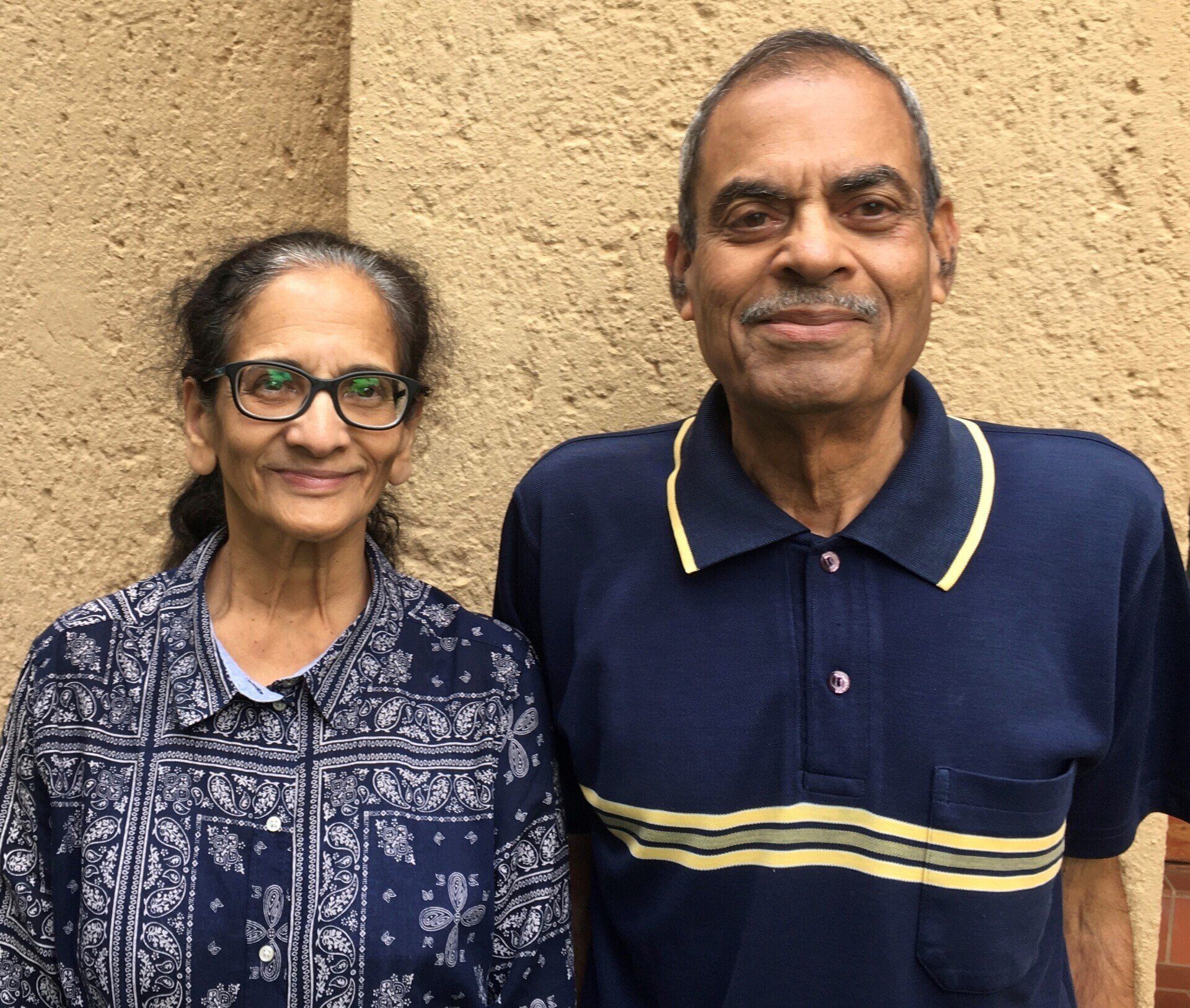
If you are wondering how you can contribute to God’s kingdom, then you will find inspiration from two young-at-heart disciples in Pretoria, South Africa. Uncle Chandra (76) and Aunty Meenu (67) Gopalan are devoting themselves to the ministry of prayer. They spend time every day praying for the church in Southern Africa, the government, and also offer up individual requests.
Both previously practised Hinduism, but became disciples in Milwaukee, Wisconsin (USA) in 2009 when they visited their son Raj; they were impacted by the sacrificial love of Jesus on the cross and the hope of resurrection. After their baptisms, the couple served the church in Doha, Qatar, where Chandra was working at the time. They now live in Pretoria, South Africa, where Raj serves as campus minister and teacher in the Tshwane church.
The retired couple explain how they embraced the ministry of prayer.
What made you decide to take up this ministry?
Servitude was instilled in me (Chandra) from a young age. I had to serve my family in a variety of ways due to forced circumstances, and Meenu supported me very ably, and it continued later in my life as a disciple. Normally, when someone retires, they would go back to the country familiar to them. But God had a different plan and brought us to South Africa. As Christians, we live in a community of believers. We feel at home, and want to serve our wonderful biological and spiritual families. As a retired person with limited resources, I was at a loss as to how we could serve our spiritual family in a new country. I use a Bible app for my quiet times, and one day I read that I could stay at home and pray as a way to serve. Instead of feeling helpless, God opened a door for us to serve his kingdom. Around the same time, there was an opportunity for us to pray for one of the brothers. We added his prayer request to our daily prayer for our biological family. A week or two later the brother came back joyful and shared that God had indeed answered our prayers.
How do you get prayer requests?
We talked to our church leaders, Themba and Zama Xulu, about our desire to pray for our spiritual family. They made a prayer box that we used to bring to church every Sunday for people to drop in their requests. Because the COVID-19 pandemic put a halt to in-person services, we switched to a social messaging service.
When do you pray?
We start early in the morning after our quiet times in the Bible. We usually complete the whole prayer in one sitting, or break it up into two or three segments if there are unavoidable disruptions.
What do you pray about?
We pray for our biological family, our spiritual family in general, the country and the government, the world at large, our local and international family of churches; protection and healing from COVID; a return to normalcy of life all over the world, and individual requests.
Do you get feedback about answered prayers?
Yes and no. Some brothers and sisters are very prompt in getting back to us immediately, and our response is to praise and thank God for his grace, mercy and generosity. Yet, in other instances, we contact people for feedback. Oftentimes, we don’t know who we are praying for as there’s no name attached.
What is your approach to prayer?
We believe that when we pray for others, we should pray with the same concentration and zeal as if we’re praying for ourselves. We are pouring our hearts out to our Almighty God. It is a privilege, and we believe that we need to be diligent. We must remember to thank God for answering our prayers. It’s essential to express our gratitude.
What encourages you most about being able to pray for others?
It is simple. To anyone who desires to offer something of great value with the least physical effort and without much resources, prayer is the best way forward. It’s a great way to fellowship with our Father in heaven. We serve a loving, merciful, generous, compassionate, gracious, glorious God, and it’s a privilege to commune with him.
What’s your encouragement to those who may feel that they don’t have much to offer God’s kingdom?
In 1 Corinthians. 4:16, the Apostle Paul says, “So I urge you to imitate me” (NLT). Even if we don’t imitate the Apostle Paul in what he’s done or gone through, we can pray for others. We don’t need to travel far, we can do it wherever we are. All we need is a desire and heart to pray.
What are some of your favourite scriptures about praying for others?
There are too many to mention. But, one that comes to mind is the Lord’s Prayer in Matthew 6:9-13, it is a community prayer; Colossians 1:9 says, “For this reason, since the day we heard about you, we have not stopped praying for you” (NIV).
Finally, 1 Timothy 2:1-2 says, “I urge, then, first of all, that petitions, prayers, intercession and thanksgiving be made for all people — for kings and all those in authority, that we may live peaceful and quiet lives in all godliness and holiness” (NIV).
More from Southern African Churches of Christ

The physics of the pendulum Picture an old grandfather clock in a quiet hallway. Its long brass pendulum swings steadily: tick, tock, tick, tock. Now give that pendulum a hard shove to the right. It does not simply glide back to the center and stop. It races right past the middle and sways just as far to the left. Left to its own momentum, a pendulum never rests at either extreme; it finds peace only when it hangs still at the center, held by gravity and its fixed point. The church behaves in much the same way. Push her too far toward one side of a truth and she does not gently settle into balance, she swings. Often for a whole generation toward the opposite error, and then back again, wounding people at both ends of the arc. And here is the crucial thing the clock teaches us: the pendulum comes to rest not by being frozen in place, but by being held. Balance is not the absence of force; it is the fixed point that keeps opposing pulls in tension so that the weight can finally hang still.
Johannesburg church appoints Mpho and Pumla Khalo as evangelist and women's ministry leader. They serve in the Soweto region.
Campus minister Jake Graham shares about Johannesburg’s campus ministry and highlights Campus Encounter 2026 filled with teaching, fellowship and fun.