
Introducing Dr Granny "Magran" Setswe
Vida Li Sik • May 3, 2021
It took a year before Magran could celebrate with family and friends.
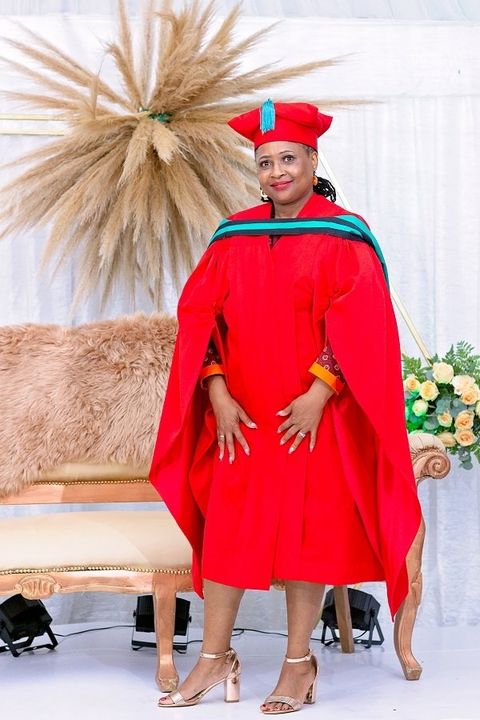
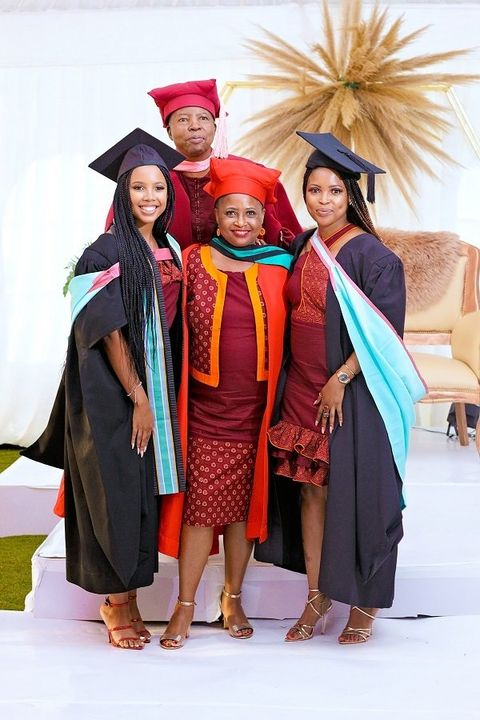
She had to wait almost a year before she could celebrate with family and friends, but on 17 April, Granny “Magran” Setswe, celebrated becoming a Doctor of Education in Curriculum Studies. The celebration of thanksgiving took place in Koster, North-West Province, where family, friends, colleagues and brothers and sisters from Tshwane, Soweto, Soshanguve and Rustenburg, gathered to encourage her.
On 25 May 2020, the University of South Africa hosted a virtual graduation ceremony for Magran and others to mark the occasion, but while she collected great memories, it just wasn’t the same as having her friends and loved ones with her.
Her doctoral degree is a specialised study in Curriculum Studies focussing on Instructional Design component. Her study was on the Use of Mobile Learning Technologies for the Professional Development of Academics at a University of Technology. “It took me six years to complete this qualification on a part-time basis,” Magran shares.
“God sustained me through this long journey that reached a successful conclusion. My supervisor and co-supervisor guided me throughout the process. My husband, Geoffrey Setswe, played a role as a coach and lover-mentor. My daughters Boipelo and Kitso kept encouraging and challenging me to strive on, even when I felt tired and sick. I also received support of continuous prayers from our spiritual family in Tshwane and Soshanguve.
All these motivated me to be more determined to continue this journey with hope. I’d say perseverance and determination on my part played a big role in this journey,” she adds.
More from Southern African Churches of Christ

Imagine you are at a neighborhood barbecue. Your new neighbor arrives late, dressed casually, and barely speaks. Someone whispers, “She thinks she’s too good for us.” You feel the quick sting of that snap judgment. Later, you learn she just lost her husband and is quietly grieving. In that moment, you sense the discomfort of judging wrongly, a rush to conclusions that harms relationships and reveals more about our own hearts than the other person. Yet, the same evening, when another guest makes a racist joke, you feel an inner nudge to speak up. Is that also “judging”? This everyday tension captures what Jesus presents in Scripture: a divine balance between grace-filled restraint and righteous discernment. The two commands in tension “Do not judge, or you too will be judged.” – Matthew 7: “Stop judging by mere appearances, but instead judge correctly.” – John 7:24 At first glance, these seem contradictory. Don’t judge. Judge correctly. Which is it? Matthew 7 warns against a critical, hypocritical spirit that condemns others while ignoring our own faults. The context continues: “For in the same way you judge others, you will be judged, and with the measure you use, it will be measured to you” (Matthew 7:2). Jesus then uses the vivid image of someone with a plank in their own eye trying to remove a speck from another’s. Notice the aim: “then you will see clearly to remove the speck.” Self-examination is not a reason to stay silent. It is how we become safe enough to speak (Matthew 7:3-5). John 7, however, shows Jesus defending his healing on the Sabbath. He challenges the religious leaders: stop superficial, appearance-based judgments and instead apply right, truthful judgment aligned with God’s character and Word. This is not a contradiction but a divine tension, two truths that must be held together. We are called to humility and self-examination (do not judge harshly or hypocritically), while also exercising discernment and moral clarity (judge correctly, according to truth). Christianity rejects both naive permissiveness (“anything goes, no one can say anything”) and harsh legalism (constant condemnation without grace).

Welcome CJ and Sheree Wakefield to Cape Town! With decades of ministry, leadership and teaching experience, they are passionate about forming apprentices of Jesus.

Here are answers to some frequently asked questions about next year’s trip to Mt. Kilimanjaro.