

"God, my desperate hope" - A testimony from a sister in Cape Town, South Africa
Vida Li Sik • May 31, 2020

We're living through some unusual times right now. Perhaps a time in our lives when the need for hope has never been greater. Gaby Beaumont-Van der Merwe has experienced numerous tragedies in her life and has lost a number of family members in brutal and painful ways. She is familiar with pain from a very young age, but has managed to take refuge in God. He is her fortress and deliverer. She shares her story in her own words:
Psalm 18:2: "The Lord is my rock, my fortress and my deliverer; my God is my rock in whom I take refuge. He is my shield and the horn of my salvation, my stronghold."
It is wonderful that God can be our stronghold, deliverer and fortress. But, he is also so much more than that! In my walk with God this is what hope in Him had become to me – He was my desperate hope. Let me tell you why.
My formative years aligned with the Zimbabwean war of independence. Wartime meant a fragile childhood wrought with great uncertainty. We travelled in convoys. Adults peppered their conversations with talk of attacks and tragedies. Each night my brother and I were put to bed underneath my parents' steel-framed bed, so that we might live if we came under attack.
My father was gunned down when I was seven years old. Beyond the devastation of losing him, I remember hoping, believing from that tender age that perhaps someone made up the story of his death. I hoped that when I got older, I would find him or that he'd find me.
By the time I reached third grade, sexual abuse became a reality for me. I hoped it would stop. I hoped the person abusing me would die. The shame of such a violation was greater than I knew how to handle. Growing up, so much fear and anxiety surrounded my thoughts. Everything was like shifting sand and I became terribly afraid that something would happen to my mom. What would happen if she died? I had hope for many things. Then the pendulum would swing and I'd would be afraid to hope – the disappointment of that unfulfilled hope became too painful to bear.
When I was in high school, my brother had an accident that left him quadriplegic. Have you experienced a life-altering event like this? Maybe it happened to you, to a family member or someone you know well. If you've been there, you'll know it involves a huge adjustment. Initially, there are lots of prayers, love, and messages of hope coming at you from all sides. Lots of cheering you on to not lose heart, to believe, to have faith, to not give up... And then, as the dust settles and the bleak reality of the permanence of the situation hits home, along come truckloads of disappointment trundling in to deposit their hopelessness in the backyard of your heart. At this point in my life, I figured I must've had my quota of bad things. Surely it was time for the scales of fairness to swing the other way and life would now be on the up?
For a while, things went really well. I met and married my first husband. We were invited to church; passed through the waters of baptism and became part of this wonderful Kingdom of God. We gave birth to a beautiful, perfect baby boy. It seemed that all the things I'd hoped and prayed for were coming to pass.
Then, in 2000, my mom was brutally murdered. I can't begin to describe to you the devastation of that loss. It crushed me. The desperate hopelessness that grew within me was like tendrils of poison curling around my heart. All the hope and security that I had in my mom, her strength, courage, and convictions –reduced to ashes. The safe space called home – that she represented – was gone. All the things we'd hoped for together smouldered out as the ashes of her cremation cooled.
After her death, I transferred that hope-in-relationship to my brother. We'd always had a close relationship. We spoke weekly, were each other's confidantes and safe spaces. Three years later, he died after a simple operation.
That was the 'nail in the coffin' for me (no pun intended) and I hit an emotional breakdown shortly after his death. I spent 10 weeks in hospital recovering. During that time, a wonderful team of medical staff and therapists gently and lovingly cheered me on the road to recovery. I don't think I would be here today without their support. God gives each of us talents and strengths and their combined effort pulled me through one of the blackest times of my life. A time when hope was so deferred I didn't have the will to still keep breathing.
A month and a half after I was discharged, my husband was killed in an accident. By that stage, I just became resigned. Resigned to death. Resigned to that there was too much beyond my control. Resigned that life is not fair.
Looking back through the years, I've not only hoped for, but also put my hope in many things - financial security; my salary; my husband's salary; creating a home and safe spaces around me; friendships; my husband and marriage. I believed my solutions lay in doctors, therapists and medication.
Common sense should tell us these things have a limited shelf life. As they 'bottomed out' on me one by one, I resolved to put my hope in nothing but myself. The irony was that I myself was unable to sustain my own hope.
So how, through these tragedies, can I share about hope? Where was the turnaround? I wish I could give it to you in a quick five-point plan. But, it's all been a journey; a process that God has very gently, patiently and purposefully worked out in my life. He is the originator of dot-to-dot pictures and is still outlining His plan in my life.
If I had to narrow it down, it was a period when we were going through a very desperate time with my youngest son. He was going through some really awful challenges at about six years old. We'd tried every intervention we knew of. I transferred my in helping him from one thing to the next. Eventually, as each option failed, I reached the bottom of the barrel. There was no more rope hang onto. I'd run out of hope to help my child.
But something very special happened at the bottom of that barrel. It was here that I got a front-row seat to see how God can take very broken circumstances and create something beautiful out of it.
Romans 8:28: "And we know that in all things God works for the good of those who love Him, who have been called according to His purpose."
I'd hoped for many things over the years. I'd been disappointed repeatedly. But this was the first time I took very baby steps to put my whole hope in God. Since I was all out of options, there was no back-up plan if things didn't work out. It was a very cautious, tentative hand that I reached out. I remember the tears pouring down my face in my brokenness and whispering, 'God, if you're there, I wish you'd show me. God if you care, I need you to really know me. I hope you don't mind me asking the questions, but I figure you're big enough..."
Even when I felt I was all out of hope, there was still that tiny flicker of one last hope.
Do you know that no matter how small your hope may be today, He can work with it if you will just reach out your hand and let Him take the driver's seat?
Isaiah 42:3: A bruised reed He will not break, and a smouldering wick He will not snuff out."
Of course, God had been there all along - had been reaching for me again and again. He'd never left me. When I reached out from my end, He was standing ready to take my hand. There was no flash of lightning, no rumbles of thunder and burning bushes. He took me as a very broken, fragile child and with baby steps, one by one, revealed His trustworthiness. His care. He was so patient and loving. Through persistence, patience and love God worked with me to build my trust and hope in Him.
Reflecting back, I see how He's taken very broken, tragic circumstances and carved something beautiful out of it. I have first-hand experience of His transforming, revolutionary power and that is what enables me to now look forward with hope. God hasn't broken a single of His promises in His word, and as I journey on, I trust Him completely that as the Bible says in Jeremiah 29:11.
He has never let me down since I reached out. Not once.
So have I figured it all out and now my life is rosy with rainbows? Not really. I'm a working mom raising two boys. My second husband passed away after an extremely difficult and extended illness that affected every area of our lives. I'm in the daily grind of being the breadwinner and seeing to my family's needs. But through this, I stand on His word.
Psalm 25:3: "No-one whose hope is in you will ever be put to shame."
I do have hope for many things, but my ultimate hope for them is rooted in God. If none of these things materialise, then it's okay. My world will not collapse and just as He has worked out the details of trashy circumstances for my good in the past, I'm confident enough to know that He's got it all in hand. It's gonna be okay, no matter what the outcome. It's all under control and I am exactly where I'm meant to be. When I'm surrendered to His will and plan for my life, then I'm actually in that calm space in the centre of the storm. The space where hope can float without being buffeted by the elements around it.
In closing, I leave you with a thought to reflect in your own life. Where does your hope lie? How secure is that hope?
My prayer for you is echoed in Paul's words in Romans 15:13: "May the God of hope fill you with all joy and peace as you trust in him, so that you may overflow with hope by the power of the Holy Spirit."
More from Southern African Churches of Christ
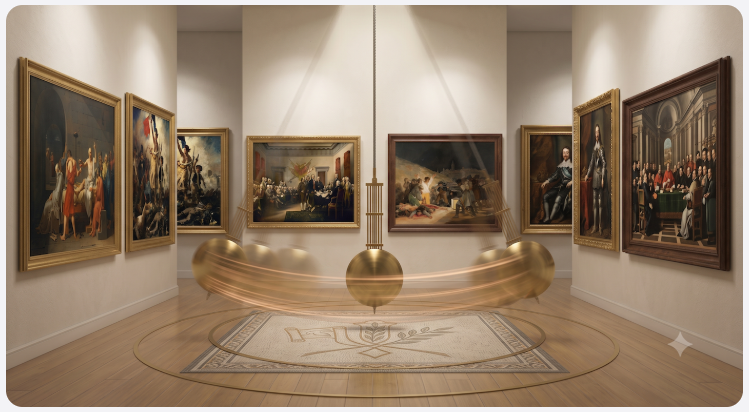
The physics of the pendulum Picture an old grandfather clock in a quiet hallway. Its long brass pendulum swings steadily: tick, tock, tick, tock. Now give that pendulum a hard shove to the right. It does not simply glide back to the center and stop. It races right past the middle and sways just as far to the left. Left to its own momentum, a pendulum never rests at either extreme; it finds peace only when it hangs still at the center, held by gravity and its fixed point. The church behaves in much the same way. Push her too far toward one side of a truth and she does not gently settle into balance, she swings. Often for a whole generation toward the opposite error, and then back again, wounding people at both ends of the arc. And here is the crucial thing the clock teaches us: the pendulum comes to rest not by being frozen in place, but by being held. Balance is not the absence of force; it is the fixed point that keeps opposing pulls in tension so that the weight can finally hang still.
Johannesburg church appoints Mpho and Pumla Khalo as evangelist and women's ministry leader. They serve in the Soweto region.
Campus minister Jake Graham shares about Johannesburg’s campus ministry and highlights Campus Encounter 2026 filled with teaching, fellowship and fun.